Showing posts with label food and farming. Show all posts

Sunday, May 3, 2009

Dirt


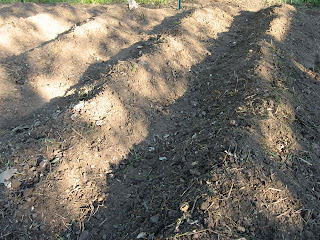
It's that time of year again - we're getting the garden ready and this time it will be 2x the size of last year's garden.  Krys has done most of the work... I tilled but she has mulched, planted and prepared the drip hose network (multi-valve drip line system comes next year).


The prep from 2008 appears to have paid off.  We combined two concepts:  sunflowers and organic weed suffocation.  The sunflowers helped provide soil structure while layers of newspaper and straw over the tiled soil helped to wipe out the pesky weeds.  When I tilled that section this year the soil looked perfect.  By mulching with more newspaper & straw this summer we will not be tilling that section again for several years - just planting cover crop in the fall then removing that in the spring for next year's garden.  As a bonus, the Lesley family who live here for 60 years before us had a large garden in this location for some time.  Not your average Avondale clay anymore.


This morning Mimi helped us sow the rem
aining seeds (okra, corn, beans, sunflowers, and 4 types of winter squash).  She likes to wal
k on top of the rows in her green yard boots.  Hopefully we will all be enjoying some succotash in a couple of months... maybe even a version of Hot+Hot's tomato salad.


Friday, January 11, 2008

There's no such thing as a Free Lunch (unless you like Corn)


I've been reading a lot about food lately.

I like to eat and like to think about what I'll eat next. But anyone who has known me for a while would know that my eating habits have changed a lot over the past 3 years. There are two reasons - the first is Krys. Long gone are the days where my diet included three food groups (pizza, hamburgers, taco bell) to the exclusion of vegetables. She can put some amazing meals on our table and she has caused me to think more about healthy eating.


But then this summer I read an article in the New York Times Magazine by Michael Pollan that completely opened my eyes about what we are really eating, and even more frighteningly where it comes from. Then I picked up his book "The Omnivore's Dilema" and learned not only about the horrible way Industrialized Food fills our tables with factory-grown livestock and corn-infused everything, but also about wonderfully redeeming ways we can grow food in a way that is healthy for our bodies and our land/community. Go read this book! This book introduces us to a guy in the Shenandoah Valley named Joel Salatin who has to have the most sustainable farm in North America. His philosophy is so consistent that he refuses to ship his meat because he doesn't want to burn the fuel of transportation and he wants to see his local agricultural economy thrive in it's place.

Pollan continues to research and write about food/agriculture - including this scary article in NYT Magazine from a couple of weeks ago. Our attempts to get More Food Quickly, we are finding, has some pretty awful consequences. The more I read about this the more frustrating it gets, though the public is beginning to wake up and smell the antibiotic-laced bacon cooking on the stove. When Congress debated the Farm Bill before Christmas there were suddenly new voices trying to be heard over those of ADM, General Mills & ConAgra: ordinary folks who eat food are starting to get very concerned about what they consume - and they are demanding change...


This whole issue is part of the reason Krys and I want to grow much of our own food at home. Not only is it fun to plant something and then 4 months later feed yourself with it, but the garden's fresh food is healthier (and it teaches us about patience!). And maybe our daughter will grow up actually knowing where food comes from (you mean it doesn't come from McDonald's and Publix?). And we've decided that it is worth it to pay more for food grown well than for food grown purely for profit. Sure, cheap food's first cost may be lower (cheap = cheap, right?), but the cost to our health, to the need to transport over long distances, and removal of nutrients from our soil, and the nitrogen polluting our rivers and even the Gulf of Mexico make it very, very costly. And as W Berry puts it so well, the solutions are not simplistic:

"These bogus attempts at simplification ignore or despise the real complexity of the world. And ignoring complexity make complication -- in other words, a mess... people either think they'll die before the bill comes due or somebody else will pay it. But the world is complex, and if we are to make fit responses to the world, then our thinking, not our equipment but our thoughts -- will have to be complex also."


They may be beautiful responses though -- the more complex & rigorous solutions always are. Your lunch is not free. So swallow the red pill and read Pollan's articles.